Proverbs and stories as OER, open educational resources. The focus for 2021: proverbs and stories from Africa.
Wednesday, November 17, 2021
Rethinking NaNoWriMo Midway
Friday, November 12, 2021
Martin. Basutoland
Year: 1903 [public domain]
Internet Archive: Always available.
Stories (10): The Story of Takane / How Khosi Chose a Wife / The Village Maidens and the Cannibal / Morongoe, The Snake / The Sun Chief / How Ra-Molo Became a Snake / Lelimo and the Magic Cap / The Chief and the Tigers / The Maid and the Snake Lover / The Famine. I have included two stories below: The Maid and the Snake Lover and Morongoe, The Snake.
Style: The stories are in an ornate, old-fashioned English.
Frame: none
Storytellers: The storytellers are not identified.
Additional Information: Basutoland was a British colony, now the country of Lesotho. Roughly the first half of the book is taken up with Basuto history and culture, with the other half containing myths and legends. As Minnie Martin explains in the preface, she arrived in South Africa in 1891 with her husband, a colonial official, and she set herself to learning the Sotho language. She later published two other books with legends she collected while living in southern Africa.
Story Title: The Maid and Her Snake-Lover
Tradition: a Sotho story from Lesotho
Notes: While Martin has chosen to tell the story in a highly ornate style, the plot is that of a traditional folktale, and she retains the names of the characters.
Parallels: This type of "beauty-and-the-beast" is found in many different traditions, of course; what is distinctive here is the role of the fathers in the story. For a similar snake-transformation story, but with an emphasis on a son's heroism, see the story below: Morongoe, The Snake. For a flipside, where a woman marries an animal transformed into a man, see Ngoza, a Mwanga story from Zambia in southern Africa.
THE MAID AND HER SNAKE-LOVER
When our fathers’ fathers were children, there lived in the valley of the rivers two chiefs, who governed their people wisely and with great kindness. The name of the one was Mopeli, and of the other Khosi.
Now Mopeli had a son whom he loved as his own heart, a youth, tall and brave, and fearless as the young lion. To him was given the name of Tsiu.
When Tsiu was able to stand alone and to play on the mat in front of his father’s dwelling, a daughter was born unto the chief Khosi, to whom was given the name of Tebogo.
The years passed, and Tsiu and Tebogo grew and thrived. Often the youth drove his father’s cattle down towards the lands where Tebogo and her father’s maidens worked, and many happy days were spent, while the love each bore the other grew and strengthened, even as they themselves grew older.
When the time came for Tsiu to take a wife, he went to his father and asked that Tebogo might be given him, for none other could he wed. Gladly the parents consented, and preparations were made for the wedding.
Now Tebogo had another lover, upon whom she looked with scorn, but who had vowed that never, never should she be the bride of Tsiu, so he consulted a witch-doctor, who promised to aid him. Imagine then his joy when, before the wedding feast had begun, he heard that Tsiu had disappeared. “Now,” thought he, “Tebogo shall be mine.” But the maiden turned from him in anger, nor would her parents listen to his suit.
Meanwhile, desolation hung over the home of the chief Mopeli. “My son, my son,” cried the unhappy father, but no voice replied; no son came back to rejoice his father’s heart.
When the moon had once more grown great in the heavens, an old man came to the village of Mopeli and called the chief to him. Long they talked, and greatly the people wondered. At length they arose, and, saluting each other, parted at the door of the chief’s dwelling. Mopeli then departed for the village of Chief Khosi, where he remained all night. The next day he returned to his own village, and bade his people prepare a great feast.
In the village of the Chief Khosi, also, much wonder filled the people’s minds, for they, likewise, were commanded to make ready a marriage feast, for the chief’s daughter, the lovely Tebogo, was about to be married, but none knew to whom.
Calling his daughter to him, Khosi said, “My child, your lover Tsiu has been taken from you, so it is my wish that you should marry one who has found favour in my eyes.”
“Tell me, my father,” replied Tebogo, “who is the man you have chosen for me? Let me at least know his name.”
“No, my child, that I cannot do,” answered Khosi, and with this the maiden was obliged to be content.
Behold then her horror when she was brought forth to meet her bridegroom, to find not a man, but a snake. All the people cried “shame” upon the parents who could be so cruel as to wed their daughter to a reptile.
With cries and tears Tebogo implored her parents to spare her; in vain were her entreaties. She was told to take her reptile husband home to the new hut which had been built for them, near the large pool where the cattle drank. Trembling, she obeyed, followed by her maidens, the snake crawling by her side. When she entered the hut, she tried to shut out the snake, but it darted half its body through the door and so terrified her that she ran to the other end of the hut.
The snake followed and began lashing her with its tail till she ran out of the hut down to the clump of willows which grew by the side of the pool. Here she found an old witch-doctor sitting, and to him she told her trouble.
“My daughter,” he said, “return to your hut. Do not let the snake see you, but close the door very softly from the outside and set fire to the hut. When it is all burnt down, you will find the ashes of the snake lying in a little heap in the centre of the hut. Bring them here and cast them into the water.”
Tebogo did as the old witch-doctor directed her, and while the hut was burning, many people ran from both the villages to see what had happened, but Tebogo called to them to keep away, as she was burning the snake.
When all was destroyed, she went up, took the ashes of the snake, which she found in the middle of the ruins and, putting them into a pitcher, ran with them down to the pool and threw them in. No sooner had she done so than from the water arose, not a snake, but her lover Tsiu. With a joyful cry, she flung herself into his arms, and a great shout went up from all the people gathered there.
As the lightning darts across the heaven, so the news of Tsiu’s return spread from hut to hut, and great was the people’s wonderment. The story of how he had been turned into a snake and banished to the pool until he could find a maiden whose parents would bestow her upon him in marriage, and of how the good old witch-doctor Into had revealed the secret to Mopeli, was soon told. For many days there was feasting and merry-making in the homes of Mopeli the chief and of Khosi, while in the hearts of Tsiu and his bride Tebogo there dwelt a great contentment, but the wicked lover fled to the mountains, where he cherished a bitter hatred in his heart against Tebogo and her husband, and longed for the time when he could be revenged.
Story Title: Morongoe, The Snake
Tradition: a Sotho story from Lesotho
Notes: Again, Martin tells the story in a highly literary style, while continuing to use the Sotho names of the characters. She also uses the word "kaross" in the story, but I have changed that simply to cloak.
Parallels: By comparing this story with the story above about the transformed snake, you can see how folktale traditions can weave very different stories out of similar motifs. For another story of cattle-under-the-water, see this Lozi story from southern Africa: Mange (from Stirke's Barotseland).
Wednesday, November 10, 2021
Ellis. Negro Culture in West Africa
Author(s): George Washington Ellis (1875-1919)
Illustrations: There are a few photographs included.
Year: 1914 [public domain]
Internet Archive: Always available.
Stories (52): The Rival Sleepers / The Man and the Goat / The Three Brothers and the Town / Man Hunting / The Race for a Wife / The Two Blind Men / Why the Elephant Runs from the Goat / Rival Brothers / The Fly, The Crab, and The Minnow / The Man and the Crabs / The Rival Doctors / The Man and his Chicken / Three Men Want First Smoke / Two Boys and the Snake / The Rabbit, The Snake, and the Ground Squirrel / The Deer and the Snail / The Tide and the Minnow / Three Rival Brothers / Rival Storytellers / Two Poor Men / Two Men Frightened / The Old Lady and the Little Boy / The Blind and Legless Men / The Spider and his Medicine / The Fox and the Goat / The Old Lady and the Bird / Three Royal Lovers / Two Bad Young Men / The Two Faithful Friends / The One Eyed Monarch / Poor Man and King's Daughter / The Blind Mori Man / The Little Boy and the Snake / The Two Thieves / The Father and Three Sons / The King and His Bangle / The Mori Man and the Secret / The Jealous Husband / The Man, The Deer, The Possum, and the Snake / The Lion, The Fox, and the Monkey / Two Great Swimmers / The Two Fighters / The Two Brothers / Two Unfortunate Men / The Lion, The Leopard, and the Dog / Three Storytellers / The Leopard and the Goat / Two Old Women / Two Orphan Brothers / Value of Education and Money / The Rascal Man / The Six Rival Heirs. I have included two stories below: The Man, The Deer, The Mongoose, and the Snake and Two Orphan Brothers.
Style: These stories are told in English.
Frame: None.
Storytellers: The names of the storytellers are not provided.
Additional Information: Ellis was an African American lawyer who served as a diplomat in Liberia. While in Liberia, he undertook a systematic study of the culture of the Vai people, collecting a large number of folktales and also proverbs which he published in 1914.
Story Title: The Man, The Deer, The Mongoose, and the Snake
Tradition: A Vai story from Liberia
Notes: I have used "Mongoose" here, but Ellis refers to the animal as a "Possum." There are no possums in Africa, but the mongoose seemed like a good candidate for the role. There are several mongoose species in Liberia, including the so-called Liberian mongoose. This is a dilemma tale, the idea being that the audience would debate the question posed at the end.
Parallels: This story shares some common features with an Indian folktale type known as "The Grateful Animals," a story which could have likely reached Liberia through Muslim storytellers. Here is an Indian version of the story: The Grateful Animals and the Ungrateful Man.
THE MAN, THE DEER, THE MONGOOSE
AND THE SNAKE
A man cut his farm and planted plenty of cassava, and the Deer always came to the farm to eat this cassava.
The man made a trap and set it for the Deer.
The Deer was caught one day. The man went and found the Deer in the trap. He started to kill the Deer, and the Deer told him he must not kill him. “If you let me go,” said the Deer, “I will make you rich.”
The man took the Deer out of the trap. The Deer told the man to lie on his back. The man did so, and the Deer carried him far away into the big bush near a large town and left him there.
The man had a piece of cassava in his hand when he was carried into the bush, and while he was eating it that night a Mongoose came to him and told the man if the man would give him a piece of the cassava, he would make the man rich.
The man gave the Mongoose a piece, and the Mongoose went to the town and went into the King's house. The King had plenty of kola-nuts there in a jar. The Mongoose broke the jar, took the kola-nuts and strewed them all the way to the man in the big bush.
The people woke up and saw the kola-nuts scattered along, and they followed the line of the kola-nuts to the man. The people caught this man and carried him to the King, and the King bound him in a cage.
While the man was in the cage, he made another trap and caught two rats.
A Snake came to the man and told him, “If you give me these two rats, I will make you rich.”
The man gave the Snake the rats, and the Snake went and bit the King's son. The King was worried and called all the people and told them if anybody gave him medicine to cure his son, he would give that person one half of his town.
The man in the cage told the Snake, and the Snake gave him medicine to cure the King's son. The man went and cured the King's son, and the King divided his town in half and gave one half to the man who cured his son.
The man was now rich. The Deer came and said he had made the man rich. The Mongoose came, and he claimed that he had made the man rich, and finally the Snake came and contended that he had made the man rich.
Which of the three — the Deer, the Mongoose, or the Snake — made the man rich?
Story Title: Two Orphan Brothers
Tradition: Vai story from Liberia.
Notes: I feel badly for the poor Snail at the end! The author added "All's well that ends well" as the final sentence, but since that is an English saying, not a Vai proverb, I left it out, especially as things did not end well for the snail.
Parallels: The pairing up of brothers in a story is common, but the pattern of this story with the tension between the older brother protesting the younger brother's actions is unusual. I'll update this post if/when I find some parallels to this type of brother story.

TWO ORPHAN BROTHERS
Once a man had two sons, and he died. Before he died, he called his sons to him and to the elder one he said, “If your brother tells you to do anything, you must do it, no matter what it is,” and then the old man passed away.
The younger brother told the elder that they must go in the bush and live there as they had no one in the town. “All right; let's go,” said the elder brother, and they went.
When they got in the bush some distance they saw a Lion lying down sleeping. The younger brother said to the elder, “Let's kill this Lion.”
“But what have we to kill him with?” asked the elder brother. “We have no gun nor anything else.”
“I have a bow and arrow,” replied the younger brother.
“But,” said the other, “can a bow and arrow kill a Lion?”
“Don't worry,” continued the younger brother. “When Father was dying, didn't he tell you to do everything I told you?”
“Well, shoot the Lion with your arrow,” said the elder brother.
The younger brother shot the Lion with his arrow; then the Lion jumped up and ran after the two brothers. The brothers climbed up into a large tree, and the Lion left them there.
After the Lion left, they did not know how to come down, and while they were there, the Eagle came by. The elder brother asked the Eagle to carry them out of the tree. The Eagle said, “You two get on my back,” and they did so. The Eagle flew away with them and carried them into a field where there were plenty of rocks.
The younger brother said he was going to shoot the Eagle.
“You mustn't do that,” said the elder brother; “if you do, we will fall down on those rocks, and we will die.”
“Didn't my father tell you to do whatever I said?” asked the younger brother.
The elder brother said, “Well, shoot him.”
The younger brother shot the Eagle.
The brothers fell down on the rocks, and both of them died.
A Snail came along and found them dead. The Snail went into the bush, got some medicine for the elder brother, and he got up. The Snail then asked if he should make some medicine for the other brother.
“No,” answered the elder brother, “because my brother is a bad fellow. He has gotten me into plenty of trouble. Come, let's go.”
“You are as bad as your brother,” replied the Snail, “because you say I mustn't cure him.”
“Well, cure him, and you will see,” concluded the elder brother.
The Snail gave the younger brother some medicine, and he at once arose, and as soon as he got up, he said he was going to kill the Snail.
“You see; didn't I tell you?” remarked the elder brother.
The younger brother took the Snail in his bag and said to his brother, “Let's go on.”
They went into a large town. After they arrived at the town, they heard that the King was dead.
The younger brother said, “You must tell these people that we killed the King.”
“We have been dead once, and you want us to die again?” said the elder brother.
“Didn't Father say that anything I say, you must do it?” asked the younger brother.
“Well,” added the elder brother, “you go tell the people that you killed the King.”
The younger brother went and told the people, “I and my brother killed the King.”
The people caught the two brothers and put them in a cage.
The younger brother said to the people, “You must carry us into the house where the King is.” The people did so.
Then the younger brother continued, “We killed the King. But what will you give us if we cure him?”
The people answered, “If you cure the King, we will give you half of this town.”
The younger brother took the Snail that cured them from his bag and told the Snail that he must use his medicine to cure the King. The Snail cured the King.
Then the younger brother called all the people and told them, “I have cured the King.”
The people divided the town in half and gave the younger brother half.
Then the younger brother told the elder that he must stay there while he himself had to keep walking about, as he had given the elder brother plenty of trouble.
The younger brother left the town and killed the Snail.
Monday, November 8, 2021
Dayrell. Ikom Folk Stories from Southern Nigeria
Author: Elphinstone Dayrell (1869-1917)
Illustrations: There are a few black-and-white photos included in the book.
Year: 1913 [public domain]
Internet Archive: Always available.
Stories (34): How an Inkum Woman Abandoned One of Her Twins in the Forest / The Cunning Hare / The Story of Igiri and Her Husband Inkang / How Elili of Inkum Died, and Was Brought Back to Life Again / Concerning the Human Sacrifices / The Story of the Witch who Tried to Kill Her Husband / How Two Friends Fell Out: The Spider and the Grasshopper / How Ewa Abagi, an Inkum Woman, Was Drowned in the Cross River / The Story of the War between Inkum and Enfitop / How an Inkum Boy Was Drowned by His Companions / How a Father Tried to Kill One of His Sons but Failed / Concerning the Okuni Witches and Cannibalism / Of Chief Amaza, His Wife Achi, and the Tortoise / The Fate of Agbor the Hunter, Who Killed His Wife and Children / What Happened at Okuni When Anyone Was Killed by Accident / How Oghabi Poisoned His Friend Okpa / How Chief Alankor and All His Family Were Killed by a Big Frog / How the River Came into Existence / Why the Mist Rises from the Water / How Ibanang Okpong and Her Mother Were Swallowed by a Man-Eating Drum / Why the Head of the Male Goat Smells So Strong / A Story of the Great Famine / Why Edidor Killed Her Husband and Her Lover / How 'Nyambi Punished Chief Oga / How Two Bendega Young Men Changes Their Skins / Concerning the Ju-Ju against Elephantiasis / How a Cruel Inkum Chief Was Poisoned by His Slaves / How the Frog Beat the Bush Buck in a Race / Why a Python Never Swallows a Tortoise / The Game of Hide-and-Seek / Chief Kekong's Daughter 'Ndere who Married a Python / How Agbor Adam Broke the Hunting Law of Okuni / How Essama Stole Her Father's Goat in the Fatting-House / Quomodo Evenit ut Penis Primum Cum Vagina Coiit (How it Happened that the Penis for the First Time Had Intercourse with the Vagina; in Latin). I have included one story below: The Great Famine.
Style: The stories are told in literary English.
Frame: None.
Storytellers: The storyteller is acknowledged by name at the end of each story.
Additional Information: This book follows Dayrell's earlier collection of stories from southern Nigeria, published in 1910. Unlike that book, this book features an introduction where Dayrell offers some insights into how he collected and translated the stories. This book focuses on stories from the Cross River State in southern Nigeria; Dayrell was the colonial administrator of the Ikom district, with its capital at Calabar, and the phrase "Calabar people" can be used to refer generally to the people in this southeastern part of Nigeria.
Story Title: A Story of the Great Famine
Tradition: an Okuni story from southern Nigeria
Notes: This story was told by Ennenni, an Okuni woman.
Parallels: The story of the greedy trickster abandoned on the top of a tree or up in heaven is widespread, including in the Americas; for a Jamaican version of the trickster spider left in the tree see Anansi, White-Belly, and Fish. The story of the deadly nanny and counting-substitutes is also widespread and it too is an African story told by African storytellers in the Americas; here's a version collected by Joel Chandler Harris: How the Bear Nursed the Little Alligators. This story makes reference to alligators, but as there are no alligators in Africa, only crocodiles, I have changed that to crocodile. Also, there are no iguanas native to Africa, so where Dayrell said iguana, I changed that to lizard. I also did some light editing to clarify ambiguous pronouns.
A STORY OF THE GREAT FAMINE
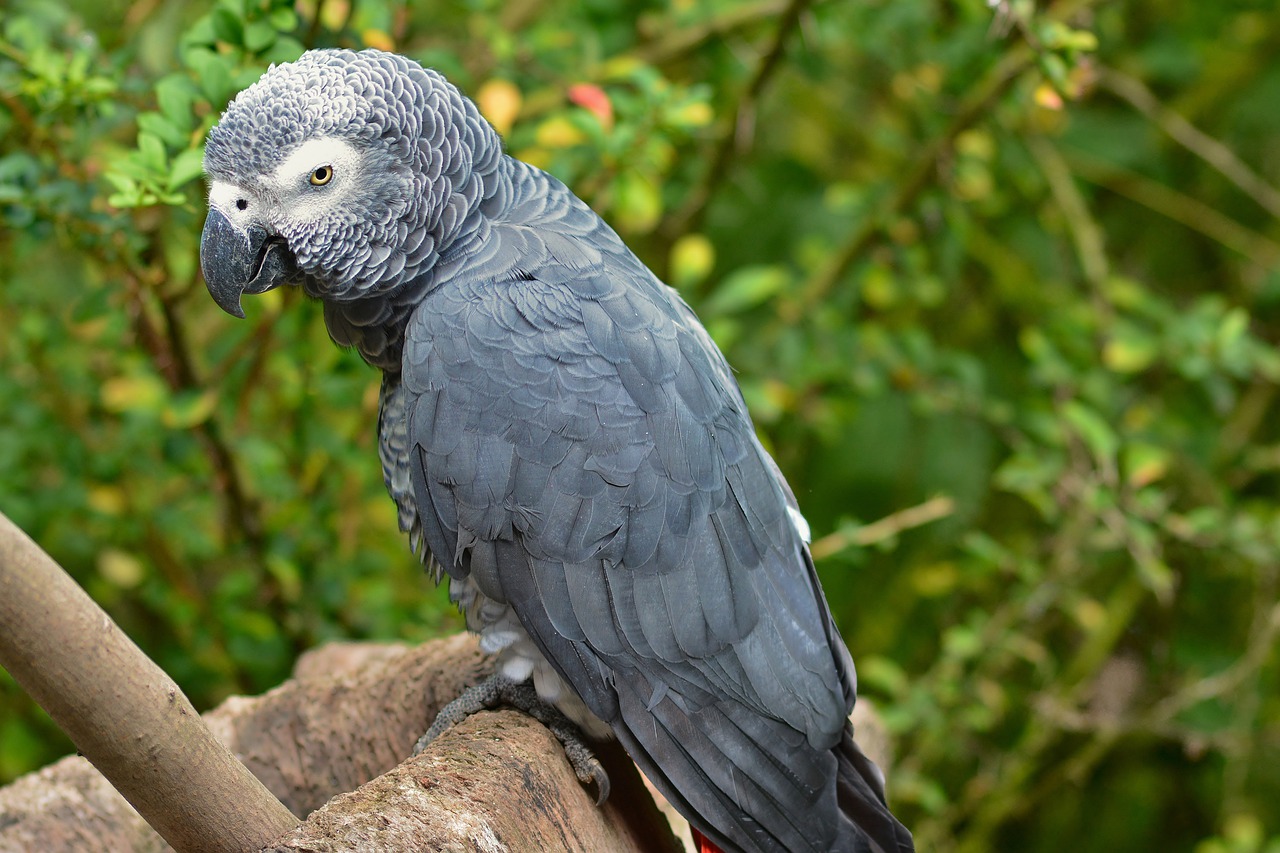
In the days of the great famine, when all men and animals on the land were starving, the crocodiles and the fish in the river had plenty to eat and the parrots and bats were also well off for food. The parrot used to fly off very early every morning with his family to an island in the river where there were plenty of palm-trees, and return in the evening carrying his bag of palm nuts with him. All the people were very jealous of the parrot in consequence, and wanted to kill him and all his family.
The hare was very curious to know how it was that the parrot always managed to get food, so he went to him pretending to be a great friend of his, but could never find him at home in the daytime, so he went in the evening and met the parrot returning home carrying his bag, full of palm nuts as usual. The hare asked the parrot where he got all the palm nuts from, and said he would like to go with him. But the parrot said that the hare could not go, and that he was only able to take his own family to the place where the palm nuts grew.
The hare then went home, but made up his mind to go with the parrot, so that very night he hid himself in the parrot's bag. At daylight the parrot put his bag round his neck and flew off with his family to the island. He then began to gather the palm nuts, and to fill up his bag. Now the palm-tree where the parrot was overhung the river, and the hare, thinking he would pay the parrot out for refusing to bring him, made a hole in the bottom of the bag so that the nuts dropped through into the water as fast as the parrot put them into the bag.
When the parrot began to eat some of the nuts, the hare ate some also, and when the parrot dropped the kernel the hare dropped his at the same time through the hole in the bag. The parrot did not notice this, as he thought that some of his family were also eating close at hand, so he continued to put nuts into the bag, but could not understand why it was that the bag did not get full. At last the parrot thought there must be a hole in the bag, so he looked inside and found the hare there.
Then the parrot said, " My friend, what are you doing in my bag? Did I not tell you that I would not take you to the place where I got my food from? You must have hidden yourself in my bag without my knowledge." He then pulled the hare out of the bag and, having placed him on the top of the palm-tree, flew off to the next tree where he was joined by the rest of his family, to whom he related the way in which he had punished the hare, and shortly afterwards they all flew home, leaving the hare on the island.
The hare managed with some difficulty to climb down the tree, but when he reached the ground he was afraid to cross over to the land from the island, as he thought the crocodiles or big fish might catch him. He looked all round the island for a place to make his house in, but it was all wet, as the river was high, so the next day he determined to swim across the river, and risk being eaten. But before the hare started he threw some small bits of dried sticks into the river and watched the fish come up and look at them. When he saw that he was bigger than the fish, he said, "They cannot eat me," and without much fear jumped into the water and began to swim across.
The fish came round the hare and saluted him, saying, "Go on your way in peace." Just as he got near the land, however, he came across a large female crocodile, who asked him where he came from and where he was going. When he said that he was swimming from the island towards the land the crocodile caught him, saying, "I want you to do me a service first, and then I will let you go."

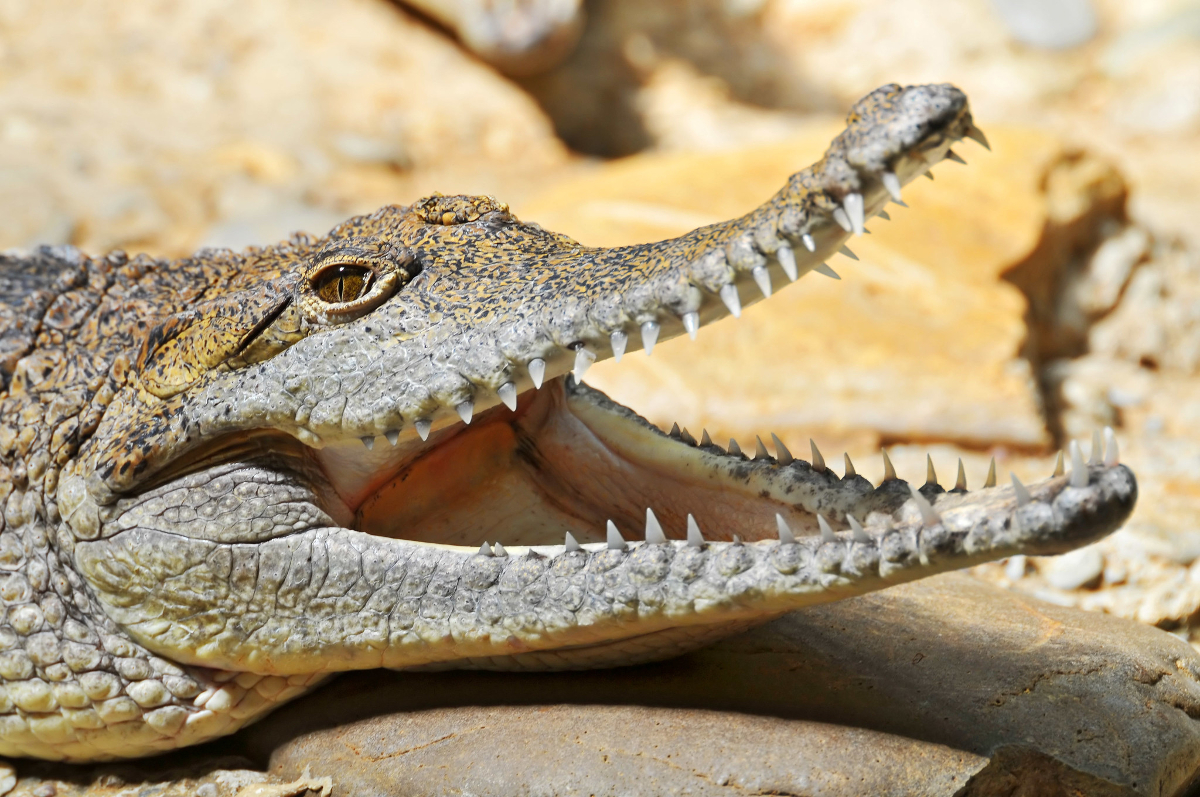
Crocodile by Tambako at Flickr
She then took the hare to her house at the bottom of the river, where she introduced him to her husband, and said, "This man can paint our children, and make them look nice to all people." At this time the crocodiles were grey-coloured without any markings, and had for some time been wanting to change their colouring.
Then the hare said, "I see you have many young crocodiles here, and I will paint them all for you, but you must not look at me while I am doing it. I will paint one of your children every day and show it to you, but you must first of all build me a house, into which you must put all your children, with plenty of food and firewood."
The next day the crocodiles built the house, and did everything the hare told them, a small hole being left in the wall of the house so that the hare could show the crocodiles each child as he painted it. The hare then went into the house and shut the door carefully. That day he painted the crocodiles' eldest son with long dark stripes across his body, and when he had finished he held the young crocodile up to the hole for his parents to see, and asked them if they were satisfied. The old crocodiles told the hare that he had painted their son very well, and they were pleased. So the hare put the young crocodile on the ground and closed the hole.
That evening the hare killed one of the young crocodiles and ate it. The next day he held up the crocodile he had already painted to the hole for the old ones to see, and then put it down again, closing the hole as before. When night came he again killed another young crocodile and ate it. The same thing happened every night until the hare had eaten all the young crocodiles except the one he had painted and showed to the parents each morning.
The hare then told the crocodiles that he had finished painting all their children, and wanted to go home, but he told them that they must not go into the house until after he had gone, as if they did, his magic ju-ju would be broken and all the painting would be spoiled. He also asked them to allow him to be rowed across the river by a lizard, who is deaf and cannot hear anyone shouting.
The crocodiles agreed to this, and told the lizard to bring his canoe and paddle the hare across the river. They then gave the hare presents of fish and yams, and said good-bye to him. The hare then got into the canoe and pushed off, and the lizard commenced to paddle him over.
When they had gone a little distance the father crocodile went to the house where the hare had been, and when he looked in he found only his eldest son who had been painted, so he asked him where the other children were, and his son replied that the hare had eaten one of his brothers or sisters every night until he was the only one left. When the crocodile heard this he was wild with rage, and went up the bank and called to the lizard to bring the hare back, but as the lizard was deaf, the lizard took no notice. When the hare heard the crocodile shouting and waving from the bank, he attracted the lizard's attention and made him understand that the crocodile was so pleased at the good work the hare had done that he wished the lizard to row faster, so the lizard paddled harder than before.
Seeing that the canoe did not return, the crocodile dived into the river and swam after the canoe, but before he could catch it the hare had jumped to the land and ran up the bank. The crocodile then scrambled up the bank to where the hare was sitting, and asked him why he had killed and eaten his children, and told the hare he should kill him. The hare acknowledged that he had done wrong, but asked the crocodile not to kill him at once, as his body was so small it would not be worth eating. He then advised the crocodile to dig a pit and put sharp stakes, with their points upwards, in the bottom. The hare said, "If you do this, and then throw me up in the air as high as you can, so that my body will fall into the pit on the sharp stakes, then I shall die in great pain, and in three days' time my body will be much swollen and will then be better worth eating."
The crocodile thought this a good plan, and agreed to what the hare said, so he dug a pit and put the sharp sticks in the bottom. The crocodile then threw the hare into the air as high as he could, and the hare fell into the pit but was careful not to be caught on the sharp sticks. The hare then commenced to scream with pain, pretending to be in great agony. So the crocodile said, "Now I have got you, you cunning hare!" and walked away to the river. The crocodile then swam home and told his wife, who was mourning her children, of the revenge he had taken upon the hare.
The next morning he went to the pit to see if the hare had grown any larger, but when he looked in he found that the hare had disappeared. He then made enquiries from some other animals about the hare, and they told him that the hare was alive and they had seen him running home.
When the hare got home, he went to the parrot and told him what had happened to him, and warned the parrot that he should do his best to kill him for leaving him on the palm-tree to the danger of his life, unless for the future the parrot lived by the waterside, as that was where the parrot got his food from. Then the parrot was frightened, and moved his house to the top of a high tree on the island. Ever since that time the parrots have made their nests on high trees on islands, and when they are flying high up in the air you can hear them laughing at the hare, saying, "We are out of your reach; you cannot harm us now." And even at the present time you can see that the young crocodiles have stripes across their bodies, but the skin of the old ones, which is very rough, does not show the marks made by the hare, except on the tail part.
Saturday, November 6, 2021
Dayrell. Folk Stories from Southern Nigeria
Author(s): Elphinstone Dayrell (1869-1917)
Year: 1910 [public domain]
Internet Archive: Always available.
Stories (40): The Tortoise with a Pretty Daughter / How a Hunter obtained Money from his Friends the Leopard, Goat, Bush Cat, Cock, and how he got out of repaying them / The Woman with Two Skins / The King's Magic Drum / Ituen and the King's Wife / Of the Pretty Stranger who Killed the King / Why the Bat flies by Night / The Disobedient Daughter who Married a Skull / The King who Married the Cock's Daughter / The Woman, the Ape, and the Child / The Fish and the Leopard's Wife; or, Why the Fish lives in the Water / Why the Bat is Ashamed to be seen in the Daytime / Why the Worms Live Underneath the Ground / The Elephant and the Tortoise; or, Why the Worms are Blind and why the Elephant has Small Eyes / Why a Hawk kills Chickens / Why the Sun and the Moon live in the Sky / Why the Flies Bother the Cows / Why the Cat kills Rats / The Story of the Lightning and the Thunder / Why the Bush Cow and the Elephant are bad Friends / The Cock who caused a Fight between two Towns / The Affair of the Hippopotamus and the Tortoise; or, Why the Hippopotamus lives in the Water / Why Dead People are Buried / Of the Fat Woman who Melted Away / Concerning the Leopard, the Squirrel, and the Tortoise / Why the Moon Waxes and Wanes / The Story of the Leopard, the Tortoise, and the Bush Rat / The King and the Ju Ju Tree / How the Tortoise overcame the Elephant and the Hippopotamus / Of the Pretty Girl and the Seven Jealous Women / How the Cannibals drove the People from Insofan Mountain to the Cross River (Ikom) / The Lucky Fisherman / The Orphan Boy and the Magic Stone / The Slave Girl who tried to Kill her Mistress / The King and the 'Nsiat Bird / Concerning the Fate of Essido and his Evil Companions / Concerning the Hawk and the Owl / The Story of the Drummer and the Alligators / The 'Nsasak Bird and the Odudu Bird / The Election of the King Bird. I have included one story below: The King's Magic Drum.
Style: The stories are told in somewhat literary English, with notes explaining specific words and details.
Frame: none.
Storytellers: There is not an actual introduction by Dayrell, so we do not get any information about just how, where, or why he collected these stories.
Additional Information: Dayrell, who was a colonial administrator in Nigeria, is also the author of another book of Nigerian folktales: Ikom Folk Stories from Southern Nigeria. The introduction to this book is by Andrew Lang who provides a hodge-podge of comparative comments (but very Euro-centric; instead of placing these stories in an African context, he focuses on European parallels). In addition to this story about the trickster tortoise, there are many other tortoise stories in the book, as you can see in this Internet Archive search: Tortoise.
Story Title: The King's Magic Drum
Tradition: Calabar story from southern Nigeria
Notes: I picked this story because it is full of so many great motifs, along with an example of episodic construction: the story of the magic drum segues into the story of the magic fu-fu tree, which is basically a different story entirely but one that plays with the same themes of greed and rule-breaking. Calabar is in southern Nigeria, and the Igbo (Ibo) are one of the peoples of Nigeria, making up about 20% of Nigeria's population today. I have modified some spelling here and there (fu-fu for foo-foo, okra for ocro), and I added a few glosses also, like adding the word "magic" when the word ju-ju is used, ju-ju being a term that refers to a wide variety of western African magical practices and beliefs.
Parallels: This story about on-and-off food magic is also found in the Americas; see "Brother Breeze and the Pear Tree" in Philip Sherlock's collection of Anansi stories from the Caribbean: Anansi the Spider Man.
THE KING'S MAGIC DRUM
There was an ancient king of Calabar. He was a peaceful man, and did not like war. He had a wonderful drum, the property of which, when it was beaten, was always to provide plenty of good food and drink. So whenever any country declared war against him, he used to call all his enemies together and beat his drum; then to the surprise of everyone, instead of fighting the people found tables spread with all sorts of dishes, fish, fu-fu, palm-oil chop, soup, cooked yams and okras, and plenty of palm wine for everybody. In this way he kept all the country quiet and sent his enemies away with full stomachs, and in a happy and contented frame of mind.
There was only one drawback to possessing the drum, and that was: if the owner of the drum walked over any stick on the road or stept over a fallen tree, all the food would immediately go bad, and three hundred Igbo men would appear with sticks and whips and beat the owner of the drum and all the invited guests very severely.
Efriam Duke was a rich man. He had many farms and hundreds of slaves, a large store of kernels on the beach, and many puncheons of palm-oil. He also had fifty wives and many children. The wives were all fine women and healthy; they were also good mothers, and all of them had plenty of children, which was good for the king's house.
Every few months the king used to issue invitations to all his subjects to come to a big feast, even the wild animals were invited; the elephants, hippopotami, leopards, bush cows, and antelopes used to come, for in those days there was no trouble, as they were friendly with man, and when they were at the feast they did not kill one another. All the people and the animals as well were envious of the king's drum and wanted to possess it, but the king would not part with it.
One morning, one of the king's wives took her little daughter down to the spring to wash her, as she was covered with yaws, which are bad sores all over the body. The tortoise happened to be up a palm tree, just over the spring, cutting nuts for his midday meal; and while he was cutting, one of the nuts fell to the ground, just in front of the child. The little girl, seeing the good food, cried for it, and the mother, not knowing any better, picked up the palm nut and gave it to her daughter. Directly the tortoise saw this, he climbed down the tree and asked the woman where his palm nut was. She replied that she had given it to her child to eat.
Then the tortoise, who very much wanted the king's drum, thought he would make plenty palaver over this and force the king to give him the drum, so he said to the mother of the child, "I am a poor man, and I climbed the tree to get food for myself and my family. Then you took my palm nut and gave it to your child. I shall tell the whole matter to the king and see what he has to say when he hears that one of his wives has stolen my food." For this, as everyone knows, is a very serious crime according to native custom.
The queen then said to the tortoise, "I saw your palm nut lying on the ground and, thinking it had fallen from the tree, I gave it to my little girl to eat, but I did not steal it. My husband the king is a rich man, and if you have any complaint to make against me or my child, I will take you before him."
So when she had finished washing her daughter at the spring she took the tortoise to her husband and told him what had taken place. The king then asked the tortoise what he would accept as compensation for the loss of his palm nut, and offered him money, cloth, kernels or palm-oil, all of which things the tortoise refused one after the other.
The king then said to the tortoise, "What will you take? You may have anything you like."
And the tortoise immediately pointed to the king's drum and said that it was the only thing he wanted.
In order to get rid of the tortoise the king said, "Very well, take the drum," but he never told the tortoise about the bad things that would happen to him if he stepped over a fallen tree, or walked over a stick on the road.
The tortoise was very glad at this and carried the drum home in triumph to his wife and said, "I am now a rich man and shall do no more work. Whenever I want food, all I have to do is to beat this drum, and food will immediately be brought to me and plenty to drink."
His wife and children were very pleased when they heard this and asked the tortoise to get food at once, as they were all hungry. This the tortoise was only too pleased to do, as he wished to show off his newly acquired wealth, and was also rather hungry himself, so he beat the drum in the same way as he had seen the king do when he wanted something to eat, and immediately plenty of food appeared, so they all sat down and made a great feast.
The tortoise did this for three days, and everything went well; all his children got fat and had as much as they could possibly eat. He was therefore very proud of his drum, and in order to display his riches he sent invitations to the king and all the people and animals to come to a feast. When the people received their invitations they laughed, as they knew the tortoise was very poor, so very few attended the feast, but the king, knowing about the drum, came, and when the tortoise beat the drum, the food was brought as usual in great profusion, and all the people sat down and enjoyed their meal very much. They were much astonished that the poor tortoise should be able to entertain so many people, and told all their friends what fine dishes had been placed before them and that they had never had a better dinner. The people who had not gone were very sorry when they heard this, as a good feast, at somebody else's expense, is not provided every day. After the feast all the people looked upon the tortoise as one of the richest men in the kingdom, and he was very much respected in consequence. No one, except the king, could understand how the poor tortoise could suddenly entertain so lavishly, but they all made up their minds that if the tortoise ever gave another feast, they would not refuse again.
When the tortoise had been in possession of the drum for a few weeks he became lazy and did no work but went about the country boasting of his riches and took to drinking too much. One day after he had been drinking a lot of palm wine at a distant farm, he started home carrying his drum, but having had too much to drink, he did not notice a stick in the path. He walked over the stick, and of course the drum's magic ju-ju was broken at once. But he did not know this, as nothing happened at the time, and eventually he arrived at his house very tired and still not very well from having drunk too much. He threw the drum into a corner and went to sleep.
When he woke up in the morning the tortoise began to feel hungry, and as his wife and children were calling out for food, he beat the drum, but instead of food being brought, the house was filled with Igbo men, who beat the tortoise, his wife and children, badly. At this the tortoise was very angry and said to himself, "I asked everyone to a feast, but only a few came, and they had plenty to eat and drink. Now, when I want food for myself and my family, the Igbos come and beat me. Well, I will let the other people share the same fate, as I do not see why I and my family should be beaten when I have given a feast to all people."
He therefore at once sent out invitations to all the men and animals to come to a big dinner the next day at three o'clock in the afternoon.
When the time arrived many people came, as they did not wish to lose the chance of a free meal a second time. Even the sick men, the lame, and the blind got their friends to lead them to the feast. When they had all arrived, with the exception of the king and his wives, who sent excuses, the tortoise beat his drum as usual and then quickly hid himself under a bench where he could not be seen. His wife and children he had sent away before the feast, as he knew what would surely happen.
Directly he had beaten the drum three hundred Igbo men appeared with whips and started flogging all the guests, who could not escape as the doors had been fastened. The beating went on for two hours, and the people were so badly punished that many of them had to be carried home on the backs of their friends.
The leopard was the only one who escaped, as directly he saw the Igbo men arrive he knew that things were likely to be unpleasant, so he gave a big spring and jumped right out of the compound.
When the tortoise was satisfied with the beating the people had received, he crept to the door and opened it. The people then ran away, and when the tortoise gave a certain tap on the drum, all the Igbo men vanished.
The people who had been beaten were so angry and made so much palaver with the tortoise that he made up his mind to return the drum to the king the next day. So in the morning the tortoise went to the king and brought the drum with him. He told the king that he was not satisfied with the drum and wished to exchange it for something else; he did not mind so much what the king gave him so long as he got full value for the drum, and he was quite willing to accept a certain number of slaves, or a few farms, or their equivalent in cloth or money.
The king, however, refused to do this, but as he was rather sorry for the tortoise, he said he would present him with a magic fu-fu tree, which would provide the tortoise and his family with food, provided he kept a certain condition. This the tortoise gladly consented to do. Now this fu-fu tree only bore fruit once a year, but every day it dropped fu-fu and soup on the ground. And the condition was, that the owner should gather sufficient food for the day, once and not return again for more. The tortoise, when he had thanked the king for his generosity, went home to his wife and told her to bring her calabashes to the tree. She did so, and they gathered plenty of fu-fu and soup quite sufficient for the whole family for that day and went back to their house very happy.
That night they all feasted and enjoyed themselves. But one of the sons, who was very greedy, thought to himself, "I wonder where my father gets all this good food from? I must ask him."
So in the morning he said to his father, "Tell me where do you get all this fu-fu and soup from?"
But his father refused to tell him, as his wife, who was a cunning woman, said, "If we let our children know the secret of the fu-fu tree, some day when they are hungry, after we have got our daily supply, one of them may go to the tree and gather more, which will break the magic ju-ju of the tree."
But the envious son, being determined to get plenty of food for himself, decided to track his father to the place where he obtained the food. This was rather difficult to do, as the tortoise always went out alone and took the greatest care to prevent anyone following him. The boy, however, soon thought of a plan and got a calabash with a long neck and a hole in the end. He filled the calabash with wood ashes, which he obtained from the fire, and then got a bag which his father always carried on his back when he went out to get food. In the bottom of the bag the boy then made a small hole and inserted the calabash with the neck downwards, so that when his father walked to the fu-fu tree he would leave a small trail of wood ashes behind him.
Then, when his father, having slung his bag over his back as usual, set out to get the daily supply of food, his greedy son followed the trail of the wood ashes, taking great care to hide himself and not to let his father perceive that he was being followed. At last the tortoise arrived at the tree and placed his calabashes on the ground and collected the food for the day, the boy watching him from a distance. When his father had finished and went home the boy also returned, and having had a good meal, said nothing to his parents, but went to bed.
The next morning he got some of his brothers, and after his father had finished getting the daily supply, they went to the tree and collected much fu-fu and soup, and so broke the magic ju-ju.
At daylight the tortoise went to the tree as usual, but he could not find it, as during the night the whole bush had grown up, and the fu-fu tree was hidden from sight. There was nothing to be seen but a dense mass of prickly tie-tie palm.
Then the tortoise at once knew that someone had broken the magic ju-ju of the tree and had gathered fu-fu from the tree twice in the same day, so he returned very sadly to his house and told his wife. He then called all his family together and told them what had happened and asked them who had done this evil thing. They all denied having had anything to do with the tree, so the tortoise in despair brought all his family to the place where the fu-fu tree had been but which was now all prickly tie-tie palm and said, "My dear wife and children, I have done all that I can for you, but you have broken my magic ju-ju; you must therefore for the future live on the tie-tie palm."
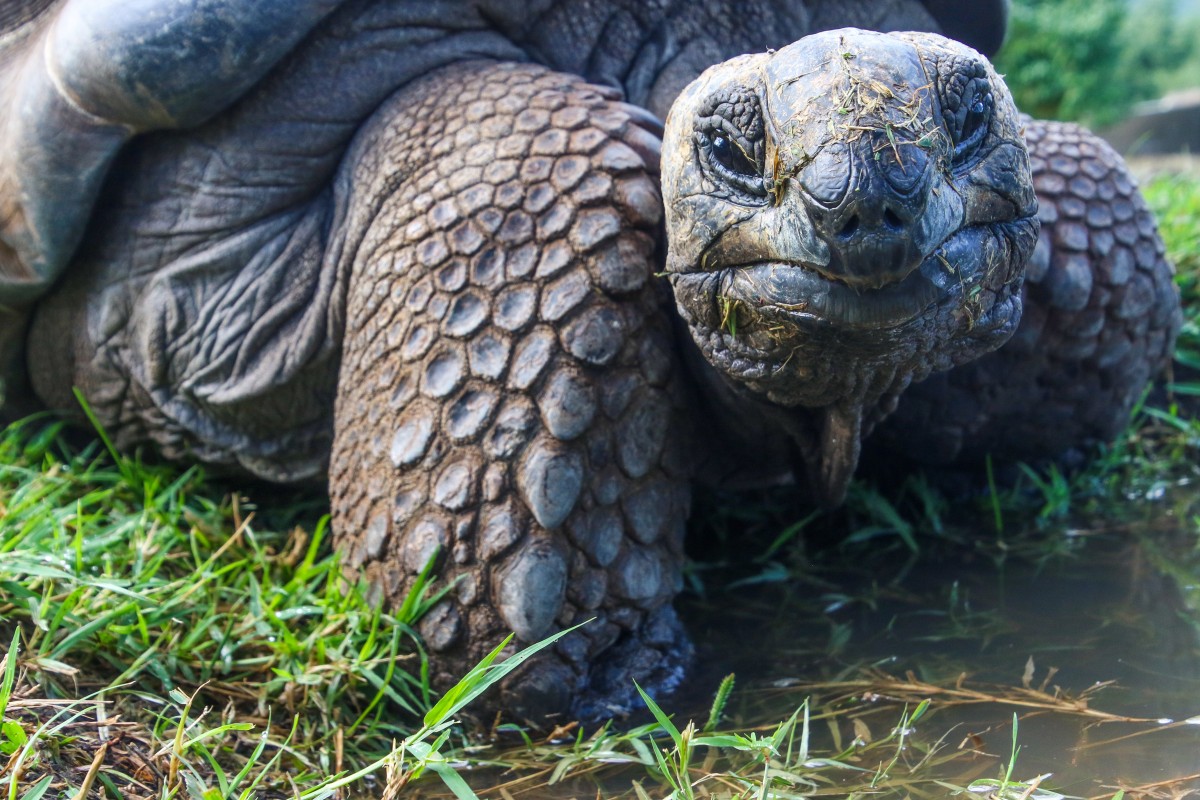
So they made their home underneath the prickly tree, and from that day you will always find tortoises living under the prickly tie-tie palm as they have nowhere else to go to for food.
Thursday, November 4, 2021
Boas-Simango. Tales and Proverbs of the Vandau
Author(s): Franz Boas (1858-1942) and C. Kamba Simango (1890-1966)
Journal: Journal of American Folklore
Year: 1922 [public domain]
Internet Archive: Always available.
Stories (20): : Baboon and Hare / Baboon and Hare (again) / Hare and Baboon / The Digging of the Well by the Animals / Hare and Turtle / Hare and Duiker (two versions) / Lion and Hare (two versions) / The Death of Hare / Turtle and Elephant / Why the Elephant Lacks a Tail / Hyena and the Moon / Tale about the Death of the People / Nshunshu / Two Men Who Married Two Sisters / The Cure of a Jealous Person / The Story of the Crocodile / The Mistress and Her Slave / The Three Brothers and the Revived Princess / The Sky People / The Hyena and the Crane. I have included three stories below: Hare and Duiker, The Death of Hare and The Digging of the Well.
Style: These are literal translations of the Chindau texts, and the Chindau text is also provided.
Frame: none
Storyteller: C. Kamba Simango
Additional Information: In addition to the stories, this article also contains a brief selection of Chindau proverbs. Simango provided the stories in Chindau (a Bantu language), and then he and Boas worked together on the translations and notes. Boas was one of the most important anthropologists of the 20th century. He is best known for his work with indigenous American peoples, especially in the Pacific Northwest, but he was also a great champion of both African and African American culture. Zora Neale Hurston was one of Boas's students in the 1920s, and Simango was also one of Boas's students. Simango was born in Mozambique in 1890 and spent most of his life there as a missionary and educator; he died in 1966. In came to the United States in 1914 to study at the Hampton Institute in Virginia, and in 1919 he went to New York City to study with Boas at Columbia.
Story Title: Hare and Duiker
Tradition: Ndau story from Mozambique
Notes: Simango provided two versions of this story: version a and version b. The version below is version a. This story is a nice example of how a song can be woven into the plot of the story itself, and in a live performance, the audience might sing along, or sing the refrain (untranslated here: telele kuteku). There are three species of duiker (a tiny antelope) found in Mozambique: common duiker, blue duiker, and red forest duiker. Mphembge is the name for the duiker, and Shulo is the trickster rabbit (hare).
Parallels: Compare this a Tsonga story from southern Africa: Hare Married the Grey Antelope. For another example of a trickster turning the body of his victim into a musical instrument, see this Igbo story from Nigeria: A Tortoise and a Fowl.
Hare and Duiker
Hare and Duiker were friends.
One day Duiker said to Hare, "If I had no horns, I should be like you. If you had no ears, you would be like me."
One day while they were playing, Hare said to Duiker, "I know a way of pulling off the horns. You will be able to pull off your horns, and I shall borrow them someday."
Because Duiker wanted their friendship to be strengthened, he wanted his horns to be pulled. Therefore he said to Hare, "I want you to teach me the pulling of the horns."
Hare said to Duiker, "Let's go and look for firewood!"
When they came back with the firewood, Hare took a pot and filled it with water. He put it on the hearth. He said to Duiker, "You someday may be able to pull off your horns so that I can put them on, and someday I shall pull off my ears and you put them on. So that both of us may obtain this power of pulling off our ears and horns, it is necessary that we go into this pot on the fire one by one that our ears and horns may become pliable so that they can be pulled."
Duiker agreed to what Hare said.
Hare said to Duiker, "I shall begin to go into the pot because I know how to do it." Hare went into the pot which was on the fire. He told Duiker that when he knocked on the lid, Duiker should take it off. When Hare had entered the pot, Duiker covered the pot with the lid. There was not much fire. Hare stayed a long time in the water before he knocked on the lid. When the water was hot, Hare knocked on the lid, and Duiker uncovered it. Hare came out of the pot.
Duiker went into the pot. Hare covered it with the lid. After he had covered it, he piled firewood on the hearth. When Duiker had gone into the pot, the water was getting hot. He did not stay in very long before the water became very hot, and it was about to boil. When he felt the heat of the water, he knocked on the lid, but Hare said to him, "You have not stayed a long enough time for your horns to be soft. Don't you remember I stayed in the pot a long time? My ears do not need much time to make them soft. Your horns need a long time to make them soft."
Duiker listened to what Hare said. He let Hare cover the pot. Hare put a stone on the lid. Duiker knocked, but Hare did not uncover the pot.
The water was boiling. Duiker knocked on the lid with strength, but Hare said to him, "Your time has not come yet."
When the water was boiling, Duiker made great efforts to come out, but the lid had a stone on it. Therefore, he died in the pot.
When Duiker was cooked, Hare took his horns and made whistles, singing, —
I played with Duiker: be quiet telele kuteku.
Duiker is cooked: be quiet telele kuteku.
I took his horns: be quiet telele kuteku.
The horns of Duiker: be quiet telele kuteku.
I made a whistle: be quiet telele kuteku.
Which I am playing: be quiet telele kuteku.
Hare was singing this song and playing on the whistle made from the horns of Duiker, his friend.
Story Title: The Death of Hare
Tradition: Ndau story from Mozambique
Notes: The motif of the bird that hides its head and/or one leg under its wing, thus inducing (accidentally or on purpose) another animal to amputate its head and/or leg is one of the most popular African folktale motifs. In this story, the ambitious trickster rabbit cannot stand to be outdone by any other animal, and that pride is his undoing! Shulo is the Hare, and Kufa is the Rooster.
THE DEATH OF HARE
One day Hare was walking to the house of Rooster. When he arrived, he asked the wife of Rooster, "Where is Rooster?"
She said, ‘‘Rooster is in the house, but his head and one leg went to drink beer.”’
At first Hare did not believe what was said by the wife of Rooster. When he saw Rooster in the house standing on one leg without his head, he was very much astonished.
Hare went to his home thinking about what was done by the Rooster. When he arrived at home, he told his wife what the Rooster was doing.
The following day the Hare heard Rooster crowing. He went to Rooster’s house, and Rooster began to tell Hare what he had done and how the people had been drinking beer. Hare asked him, ‘‘How do you send your head and your leg to go and drink beer?”
Rooster said, "I cut off my head and my leg. You remember that you saw me standing on one leg, and I was without my head. I had cut off my leg and my head, and they had gone to drink beer.”
The Hare, because he was unwilling to be surpassed by Rooster, when he came home, said to his wife, ‘‘Tomorrow I want you to take a knife and cut off my head and one leg, because I want them to go and drink beer, the same as Rooster did.’’
His wife said, ‘‘You will die,” but Hare insisted that she should do what he had told her. Therefore, when day broke, his wife cut off his head and his leg, but they did not go and drink.
When the Hare failed to rise, his wife went and told the Rooster that her husband did not arise.
Rooster said, “I thought Hare was wise, but he was a fool.”
Story Title: The Digging of the Well by the Animals
Tradition: Ndau story from Mozambique
Notes: This is one of the most popular folktale types in Africa!
Parallels: Sometimes Tortoise catches Rabbit by smearing himself with pitch or tar in a tar-baby type of story; you can see that in a South African version: The Animals Dance for Water.
{insertaudio}
THE DIGGING OF THE WELL
One year which was lacking in rain there was a great drought. All the lakes were dried up. Water was not to be found in the whole country.
The chief of the animals, Lion, called all the animals together to come to his court to talk over the matter of digging a well. When the animals were assembled, Chief Lion told them, “Tomorrow all shall come to dig a well. If an animal does not come, he will not drink the water of the well. "
On the following day many animals assembled at the place which was selected, according to the order of the chief and his advisers, where the well was to be dug. The animals were to dig the well by dancing. They were to dance one by one. They composed a song which they were to sing and to dance to. This song which they composed was:
Trotting, trotting, nshe!
Stamping, stamping, dust rises,
We give this to... Hyena.
That is, the next dancer was to be Hyena. The animals were thus called one by one. They sang this song dancing, and making a large hole; but the water did not come out, because by dancing they made the hole hard. But they persisted in dancing.
When the turn of Hare came, Hare was not found. The chief sent a messenger to call Hare. The chief asked Hare why he did not come to dig the well. Hare answered, “I do not want to dig the well, because I drink dew.” The chief let him go.
When the animals grew tired dancing, they were discouraged because the water did not come.
Turtle said, “ Let me try to dig the well!”
All the animals laughed at what Turtle said. “What can you do?" Leopard said.
Turtle persisted that he be allowed to dig the well. He entered the hole and burrowed in the sand which was packed hard by the beasts. All the animals looked at what was being done by Turtle. When Turtle disappeared in the hole, he dug through to the water, and the well was full of water. The animals were glad because they saw the water.
When the sun was setting, Buffalo said to the chief, “The well should be watched, because Hare refused to help dig the well, but when he hears that we struck water, he will come to drink water in our well. He refused to dig because he did not want to work; he mentioned that he drank dew; it was an excuse, so that he might not be troubled." The chief and all the animals said, "What you say is true, Buffalo. We know Hare is very wise.”
Hyena said, “I shall watch this night to begin.”
When Hare heard that water had been dug out, he went to get honey, which he put into his calabash, and he took his calabash and went to the well to fetch water. When he arrived at the well, he said, “Haye, haye!"
Hyena said, “ What is it?"
Hare said, "I myself taste once what is in the calabash. It is done again when tie."
Hyena said, “What did you say ?”
"I myself taste once what is in the calabash. It is done again when tie."
Hyena said, “ Come here!" Hare came near and gave a taste of honey to Hyena. Hyena tasted the honey, and said to Hare, “Give me more.”
Hare said, “If you are willing to be tied, I shall give you more.”
Hyena said, “Yes, tie me."
Hare tied him, but he did not give him the honey. Hare entered the well. He dipped out water. When he had finished getting water, he disturbed it and went to his house.
The next morning Hyena was found tied, but he did not tell who had tied him.
Leopard said, “I shall watch the well this night.”
When the sun set, Hare came and said “Haye, haye!" as he had said the night before when Hyena was watching. Leopard answered in the same way as Hyena had done. Hare let him taste the honey. He tied Leopard, dipped out water, and filled his calabash. He disturbed the water.
All the animals that watched the well were tied by Hare, but they did not tell that Hare had tied them and that Hare had the thing which he gave them.
Turtle said he would watch the well that night. The animals tied by Hare laughed at him in the same way as at the time when they were digging the well. When the sun set, Turtle went into the water.
Hare arrived, and said, “Haye, haye!" He did not hear a person answer; therefore he said, “Serves them right; I knew they would tire of trying to get me." He went into the well to draw water. When he finished filling his calabash, he disturbed the water, as was his custom. When he came out of the water, his one leg remained in the water; Turtle had taken hold of the leg of Hare! Hare begged Turtle, but Turtle did not speak.
When day broke, Hare was found at the well. He was taken to the chief. The animals were very glad because Hare was captured. But Hare was wise; therefore he said to the chief, “I want to dance my dance before you judge my case.”
The chief allowed Hare to dance his dance. Hare sang his song and asked the animals who were in court to sing for him while he danced to this song:
Hare, are you going about aimlessly? When are you coming back?
Tomorrow!
Hare, are you going about aimlessly? When are you coming back?
Tomorrow!
You, Hare, if you go away, when are you coming back?
Tomorrow!
Hare, are you going about aimlessly? When are you coming back?
Tomorrow!
Hare, are you going about aimlessly? When are you coming back?
Tomorrow!
When the animals saw Hare dancing, they had a desire to dance also, and they made much dust, and Hare ran away. The chief of the animals thought that Hare was there dancing with them. The animals did not see one another on account of the dust and stabbed one another. When the dust settled, the animals looked for Hare, but Hare was not to be found.
Latest Post:
Ballads: Willie o Winsbury
One of the new projects I want to start working on for 2022 is BALLADS, and I'm getting a bit of a head start now. My goal is to write u...